

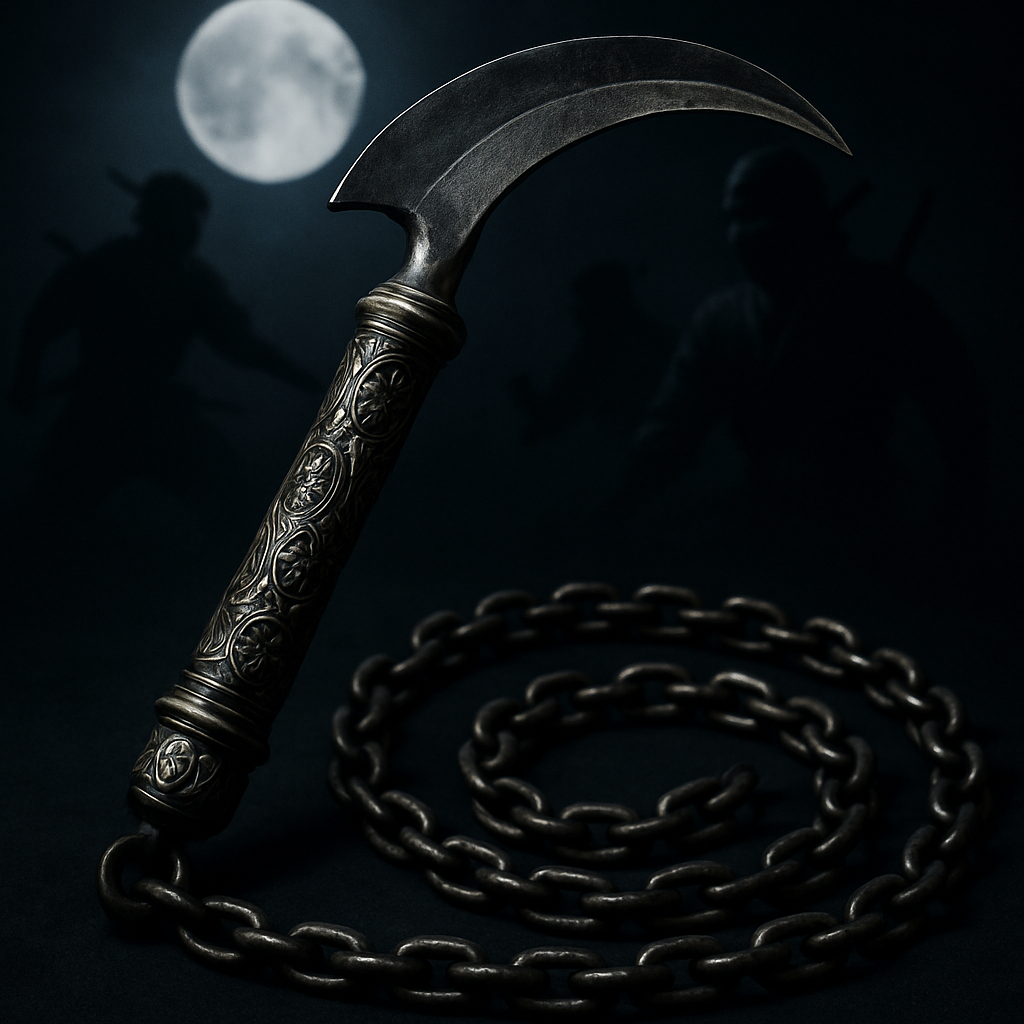
Discover the fascinating history and deadly artistry behind the kusarigama, a weapon that transformed feudal Japanese warriors into legendary shadows of the night.
When Farming Tools Became Fearsome: The Surprising Origins of the Kusarigama
Picture this: a humble farmer tending rice paddies under the sweltering Japanese sun, sickle in hand. Fast forward a few centuries, and that same tool has transformed into one of the most innovative and whimsical weapons in ninja history! The kusarigama emerged during Japan's tumultuous feudal period when creativity and resourcefulness weren't just virtues—they were survival skills. Born from necessity and ingenuity, this extraordinary weapon combined the everyday farming sickle (kama) with a weighted chain (kusari), creating something utterly magical and magnificently deadly.
What makes the kusarigama's origin story so delightfully quirky is its dual identity. During the Muromachi period (1336-1573), Japanese commoners weren't exactly allowed to parade around with swords. But a farming tool? Totally acceptable! Clever warriors and ninja realized they could weaponize their agricultural equipment without raising eyebrows. The genius addition of a chain with a weighted end transformed the simple sickle into a versatile combat system that could strike, entangle, and control opponents from multiple ranges. Talk about thinking outside the box—or in this case, outside the rice paddy!
The beauty of the kusarigama lies in its bold departure from conventional weaponry. While samurai obsessed over their pristine katanas, ninja embraced the unconventional with enthusiastic abandon. This wasn't just a weapon; it was a statement of innovation and adaptability. The kusarigama proved that the most fearsome tools don't always come from the forge—sometimes they come from the farm, reimagined by brilliantly unconventional minds who refused to play by traditional rules.
Double Trouble: How the Blade and Chain Work Together in Perfect Harmony
The kusarigama is like the ultimate tag-team duo of the weapon world—two completely different components working in perfect synchronization to create something spectacularly effective! On one end, you've got the kama, a curved blade typically ranging from 6 to 12 inches, sharp enough to slice through armor and perfectly weighted for close-quarters combat. On the other end, a chain measuring anywhere from 8 to 12 feet, tipped with a weighted metal ball (fundo) that could be whirled with mesmerizing precision. Together, they created a weapon system so versatile it could adapt to virtually any combat scenario.
Here's where things get wonderfully whimsical: the chain component wasn't just for show. It could be swung in circular patterns to create a defensive barrier, making it nearly impossible for opponents to approach. The weighted end could strike with bone-crushing force from a distance, targeting joints, weapons, or even wrapping around limbs to immobilize adversaries. Meanwhile, the sickle remained ready for devastating close-range attacks. This dual-range capability meant kusarigama wielders could control the battlefield's tempo, switching seamlessly between keeping enemies at bay and moving in for the finishing blow.
The synergy between blade and chain required extraordinary skill and coordination—kind of like patting your head while rubbing your belly, except with significantly higher stakes! Practitioners had to master independent control of both components while maintaining spatial awareness and tactical positioning. The chain could ensnare an opponent's weapon while the sickle struck, or the chain could serve as a distraction while the wielder closed distance for a blade attack. This innovative design philosophy embodied the ninja spirit: adaptability, unpredictability, and the bold courage to master something impossibly complex. No wonder this weapon became legendary!
Masters of Mayhem: Legendary Ninja Warriors Who Wielded the Kusarigama
While ninja culture emphasized secrecy and shadows, some kusarigama masters achieved legendary status that echoes through history! One of the most celebrated practitioners was Yamada Shinryukan, who founded an entire martial arts school dedicated to kusarigama techniques during the Edo period. His innovative approaches to chain manipulation and blade work transformed the weapon from a quirky tool into a sophisticated fighting system. Stories describe his ability to control multiple opponents simultaneously, using the chain to orchestrate the battlefield like a deadly conductor leading a symphony of chaos.
Then there's the absolutely fascinating tale of Shikoku Danjo, a warrior-monk who allegedly defended his temple against an entire armed force using only his kusarigama. Historical accounts describe how he used the weapon's versatility to create tactical advantages despite being vastly outnumbered. The chain allowed him to control choke points and doorways while the blade ensured any close encounters ended swiftly. Whether embellished or not, these stories capture the imagination and demonstrate why the kusarigama became such an iconic symbol of ninja ingenuity and bold combat philosophy.
Beyond individual legends, entire ninja clans incorporated kusarigama training into their curriculum. The Koga and Iga clans, two of feudal Japan's most renowned ninja organizations, recognized the weapon's tactical advantages for infiltration, assassination, and combat scenarios. Their training methods emphasized not just physical technique but the psychological aspects of wielding such an unconventional weapon. The mere sight of a kusarigama could unsettle opponents unfamiliar with its capabilities, providing a crucial mental edge. These masters understood that true mastery meant embracing the weapon's quirky nature while respecting its lethal potential—a philosophy that remains relevant in martial arts training today!
The Dance of Death: Combat Techniques That Made the Kusarigama Unstoppable
Watching a kusarigama master in action was like witnessing a mesmerizing, albeit deadly, performance! The foundational technique, called "kusarifundo jutsu," involved circular chain movements that created a protective sphere around the wielder. This wasn't just flashy showmanship—the spinning chain could deflect incoming projectiles, entangle weapons, and strike with devastating speed. Advanced practitioners could adjust the radius and velocity instantaneously, adapting to threats from any direction. The constant motion made it nearly impossible for opponents to predict attack patterns, turning combat into an intricate dance where the kusarigama wielder led with absolute authority.
One particularly innovative technique involved using the weighted chain to ensnare an opponent's weapon or limb, then using that connection as a pivot point for acrobatic maneuvers. Imagine yanking an enemy's sword aside while simultaneously spinning your body into close range, bringing the sickle blade into lethal proximity. This technique, called "karamitori" (entangling capture), exemplified the kusarigama's brilliant tactical philosophy: turn your opponent's strength into their weakness. The weapon's range flexibility meant practitioners could fight effectively anywhere from arm's length to 12 feet away, making them unpredictable and incredibly difficult to counter.
Perhaps the most whimsically effective technique was the "chain throw and recovery" method, where warriors would launch the weighted end at opponents, then use the momentum and the opponent's defensive reaction to reposition or create openings for sickle attacks. This required extraordinary hand-eye coordination and spatial awareness—skills ninja cultivated through years of dedicated training. The kusarigama wasn't about brute force; it was about intelligence, adaptability, and the bold creativity to see combat as a dynamic puzzle requiring innovative solutions. These techniques transformed feudal battlefields into stages where skilled practitioners demonstrated that unconventional thinking could overcome traditional martial advantages!
From Ancient Battlefields to Modern Dojos: The Kusarigama's Enduring Legacy
Fast forward to today, and the kusarigama continues to captivate martial artists, historians, and enthusiasts worldwide! Modern practitioners keep the ancient techniques alive through dedicated training schools, particularly in Japan where traditional martial arts (koryu) preservation remains a cultural priority. Organizations like the Isshin-ryu Kusarigamajutsu preserve authentic kata (forms) and combat applications, ensuring these innovative techniques don't vanish into history. What's particularly exciting is how modern instructors adapt historical methods for contemporary training, emphasizing the weapon's philosophical lessons about adaptability and creative problem-solving alongside physical technique.
The kusarigama has also experienced a bold resurgence in popular culture, appearing in video games, anime, manga, and films as a symbol of ninja mystique and unconventional thinking. This cultural presence has sparked renewed interest among younger generations, who appreciate the weapon's quirky complexity and the innovative spirit it represents. Martial arts enthusiasts around the globe now practice kusarigama techniques, often incorporating them into broader weapons training programs. This international adoption demonstrates how truly timeless and universal the weapon's underlying principles remain—creativity, versatility, and the courage to master something magnificently challenging.
Perhaps most importantly, the kusarigama's legacy reminds us that innovation often emerges from unconventional thinking and bold willingness to challenge established norms. Those feudal-era ninja who transformed farming tools into fearsome weapons embodied an entrepreneurial spirit that resonates today: identify resources others overlook, combine elements in unexpected ways, and commit wholeheartedly to mastering your craft. Whether you're wielding a chain sickle or navigating modern challenges, the kusarigama's lessons remain relevant: embrace the unconventional, practice relentlessly, and never underestimate the power of creative innovation. Now that's a legacy worth celebrating!